Utility & IPP · 7 min read
A Deterministic Development Framework for IPPs and Large-Scale Developers
How Renon Power upgrades energy storage projects from engineering-based delivery to certainty-driven asset delivery with distributed 10ft and C&I cabinet solutions.
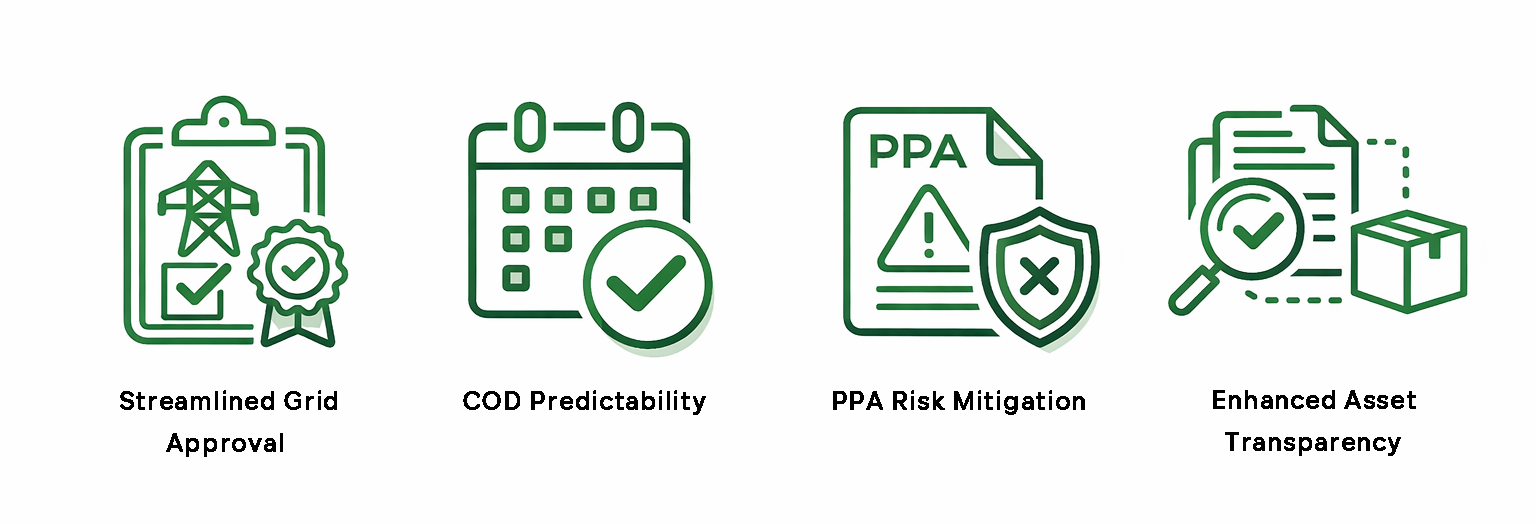
In the current power market environment, the competitive focus of energy storage projects is shifting from "capacity scale" to "delivery certainty." For IPPs and large-scale developers, the factors truly impacting project IRR are often not minor differences in system efficiency, but uncertainty in approval, commissioning, and capacity commitments.
I. Development Pressure: Time Is Becoming Cost
Under current market conditions, energy storage development commonly faces three primary pressures:
- Uncertain grid approval cycles — non-unified document standards and varying test paths lead to repetitive approvals.
- Unpredictable commissioning and Commercial Operation Date (COD) — complex system-level integration and field variables delay COD.
- Capacity commitments and default risks — structural downtime in capacity-based agreements can lead to heavy penalties.
Financial impact example (100 MW project): a six-month COD delay at an 8% discount rate over a 15-year lifecycle can drop IRR by 1.5%–2.5%. Time has become a critical financial variable.
II. Centralized Architecture: The Efficiency Solution of the Capacity Era
For IPPs, centralized energy storage has long been the most economical path. Pre-integrated PCS and control architectures, scale CAPEX advantages, and mature EPC processes solved key issues during rapid scale expansion. However, as grid congestion increases and regulations tighten, the structural limitations of centralized systems — high single-point failure impact and complex commissioning — limit flexibility once the objective shifts from "scale first" to "certainty first."
III. Distributed Architecture: From Capacity Management to Risk Management
Distributed energy storage shifts the focus from scale to granularity. By decomposing risk to the module level and commissioning to the unit level, it offers significant operational advantages — but only when a unified governance framework is established. Without one, increased modularity may amplify integration risks.
IV. Product Realization: MPack 261A & Smart Matrix A
Renon's solution is built on a three-tier architecture: node autonomy, station coordination, and system dispatch.
- Independent BMS, thermal management, and fire suppression on every module.
- Liquid-cooled module with IP54 protection.
- ≤20 ms grid-connected and off-grid switching.
- Smart Matrix A integrates PCS, battery, and EMS with built-in UPS capability.
Pre-configured and pre-commissioned modules support standardized, fully assembled transportation and rapid deployment, confining outage risks to the module level instead of full-site shutdowns.
V. Standardized Frameworks for Secure and Scalable Storage
Distributed BESS architectures bring reliability and scalability, but introduce risks: incomplete documentation, misaligned inverter/battery specs, permitting issues, and warranty misunderstandings. Certainty comes from process control, not just good equipment. The Standardized Asset Delivery Framework consists of 15 Standard Packs (covering all stages from client onboarding to digital archiving) and the DLV 9-Piece Framework (9 modules from requirement confirmation to long-term value realization).
VI. Certainty Is the New Competitive Edge
Capacity scale still matters, but development speed, structural risk control, and asset transparency are increasingly decisive. Distributed storage with a Standardized Asset Delivery Framework keeps every phase controllable and transparent — securing higher returns and stronger market competitiveness.
Original source
View on Renon Power