Critical Infrastructure · TBPP
Texas Has a Standard for Backup Power at Critical Facilities. We Build to It.
The Texas Backup Power Package Program (TBPP) defines standardized, state-engineered backup power systems for the roughly 40,000 facilities Texans rely on for health and safety — and offers grants of up to $500 per kilowatt toward them. Lumis Energy designs, builds, and installs systems to the official TBPP specifications, and gets your facility application-ready.
What Is the TBPP?
A state-engineered answer to grid failure.
After Winter Storm Uri exposed how vulnerable Texas critical infrastructure is to grid failure, the Legislature passed SB 2627 and voters ratified it in 2023. The result is codified in Chapter 34 of the Texas Utilities Code: the Texas Backup Power Package Program, administered by the Public Utility Commission of Texas.
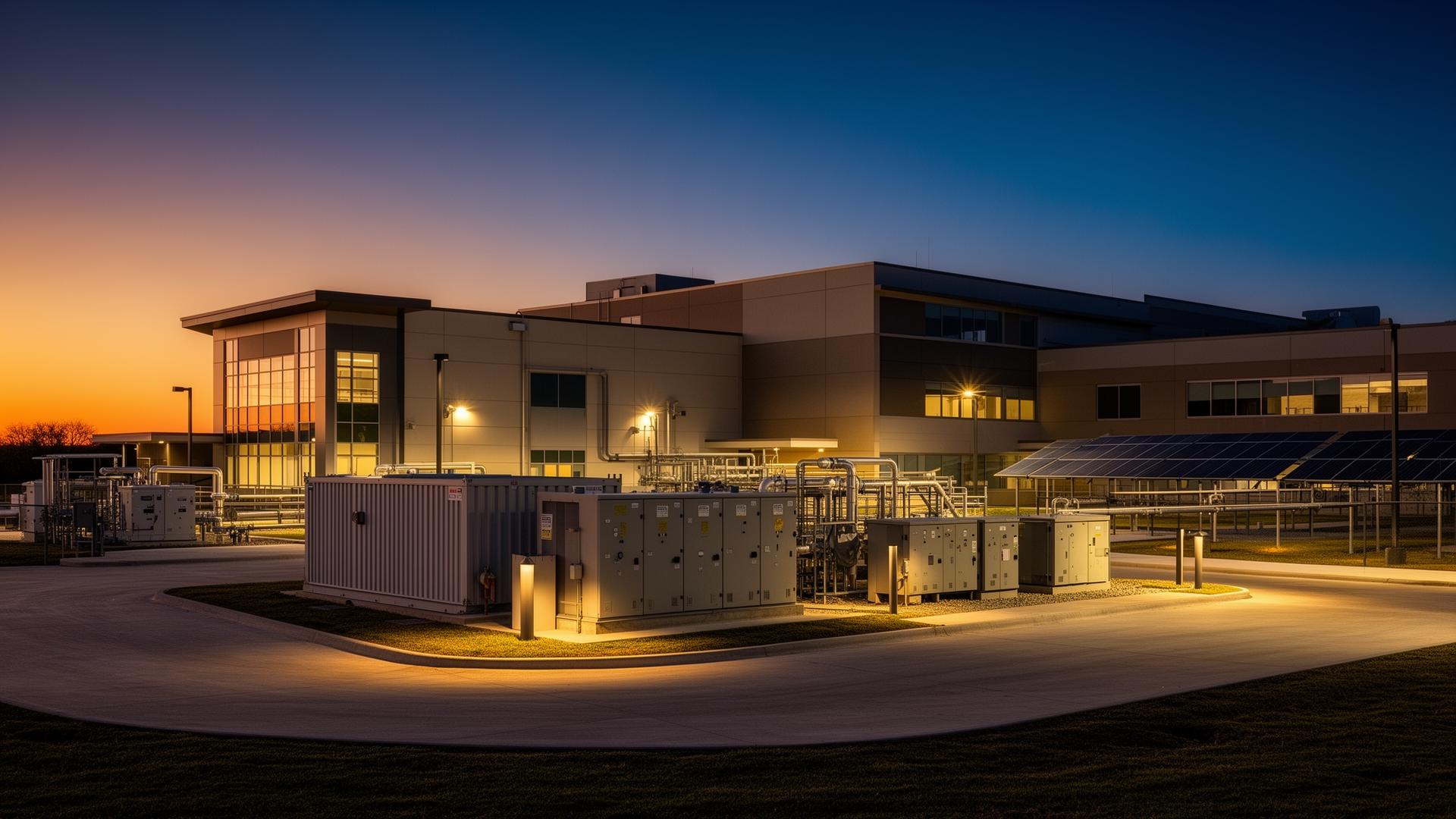
The PUCT commissioned a full engineering study (completed January 2025) that produced standardized backup power package designs in five sizes — 10kW, 25kW, 100kW, 500kW, and 1000kW — complete with technical specifications and construction drawings. Each package is a self-contained microgrid: a natural gas or propane generator, paired with solar panels and battery storage, engineered to disconnect from the grid instantly and run your facility for at least 48 continuous hours without refueling.
The program also provides grants of up to $500 per kilowatt of capacity toward a package. We'll be straight with you: the state's own report concludes the grant covers a portion of system cost, not the whole thing. What the program really gives Texas facilities is a vetted, standardized design, a defined eligibility path, and meaningful money toward resilience — and a head start to the facilities that prepare first.
The Statute
What's actually in a TBPP?
Every TBPP must, by statute, meet four non-negotiable performance requirements — and combine three independent power sources.
48+ continuous hours
Runs without refueling and without a grid connection.
Instant islanding
Battery picks up your load the moment the grid fails; generator starts seconds later.
Three power sources
Natural gas or propane generator, plus solar PV, plus battery storage.
Up to 2.5 MW
Per facility, using up to three aggregated standard packages.
Packages also serve up to 2.5 MW of load per facility (using up to three aggregated packages) and operate islanded only — they cannot sell power back to the grid. This is why a TBPP is more than "a generator": it's a fully engineered microgrid with redundant power sources, automatic transfer, and integrated controls.
The Five Standard Packages
Find your TBPP package size.
Packages aggregate — up to three units combine to match your load (e.g., 150kW facility = one 100kW + two 25kW). Roughly 60% of Texas critical facilities need 75kW or less.
Use the highest kW demand on your electric bill.
Recommended packages
100kW + 25kW + 25kW
Total capacity
150 kW
Maximum TBPP grant
$75,000
Estimated installed cost
≈ $270K–$405K
Planning estimate from PUCT 2025 research data — excludes site-specific work (foundations, fuel connections, service upgrades).
| Package | Generator | Battery | Solar | Typical fit |
|---|---|---|---|---|
| 10kW | 10kW NG/propane | 10kW / 10kWh | 2kW | Pump stations, lift stations, small sites |
| 25kW | 25kW | 25kW / 25kWh | 5kW | Fire/police stations, small clinics |
| 100kW | 100kW | 100kW / 100kWh | 20kW | Schools, municipal buildings, nursing homes |
| 500kW | 500kW | 500kW / 500kWh | 100kW | Treatment plants, large facilities |
| 1000kW | 1000kW | 1000kW / 1000kWh | 200kW | Hospitals, major infrastructure |
Eligibility
Is your facility eligible?
Chapter 34 defines critical facilities as those "on which communities rely for health, safety, and well-being." The PUCT's study identified ~40,000 across Texas, in six categories.
Hospitals & medical facilities
Hospitals, nursing homes, and other medical facilities.
First responders
Police and fire stations.
Water & wastewater
Treatment plants and pump stations.
Shelters
Storm and homeless shelters.
Schools & municipal buildings
Public schools and municipal buildings providing critical services.
Grocery & fuel stations
Grocery stores and evacuation-route fuel stations.
Not eligible
Commercial energy systems, private schools, for-profit entities that don't directly serve public safety and health, residences, and loads above 2.5MW.
What It Costs
Honest numbers.
Based on vendor pricing gathered in the PUCT's 2025 study (delivered + base installation, excluding site-specific work like foundations, fuel connections, and service upgrades).
Small packages (10–25kW)
≈ $115K–$175K
Mid-size (~100kW class)
≈ $350K–$450K
Large (500kW–1MW class)
Per-kW cost falls as size grows.
$1,800–$2,700 per kW
Stacking the funding picture
The maximum TBPP grant is $500/kW — $5,000 on a 10kW package, $50,000 on a 100kW package, $500,000 on a 1000kW package. Lumis helps you stack the picture: TBPP grant + federal programs (e.g., FEMA BRIC/HMGP where applicable) + financing or Microgrid-as-a-Service structures that eliminate the upfront cost entirely.
All figures are planning-level estimates from the PUCT research report; your actual cost depends on site conditions. We'll give you a real number.
How Lumis Helps
From eligibility to energization.
- 01
Free Eligibility & Sizing Assessment
We confirm your facility's status under Chapter 34 and size your system from your actual demand data — not a guess.
- 02
Built to the Official TBPP Specifications
We design and build to the PUCT's published TBPP technical specifications and drawing sets, so your system is engineered for program compliance from day one.
- 03
Application Readiness
We assemble the technical documentation a TBPP application needs: load profiles, sizing justification, specs, and cost estimates. (Lumis is not affiliated with the PUCT and cannot guarantee awards.)
- 04
Installation & Long-Term Support
Licensed installation, commissioning, and maintenance — so the system works on the one day it absolutely must.
Why Start Now
The window doesn't wait.
Lead times are real
The PUCT's study found 15–25 week delivery for systems through 300kW, and 25–40 weeks (up to 15–16 months) for the largest — before installation.
40,000 facilities, finite funding
When application windows move, facilities with completed sizing and documentation move first.
The grid hasn't gotten calmer
Uri, the 2023 heat dome, Beryl — the case re-proves itself every year.
FAQ
Questions, answered.
Find Out Where Your Facility Stands
Send us your facility details and a Lumis engineer will follow up with a free eligibility and sizing assessment — your package size, your grant amount, your real cost.
- Eligibility confirmation under Chapter 34
- Sized to your actual demand — not a guess
- Grant amount and installed-cost range
The Texas Backup Power Package Program is administered by the Public Utility Commission of Texas under Texas Utilities Code Chapter 34. Program rules, funding availability, and eligibility criteria are determined solely by the PUCT and are subject to change. Cost and program figures on this page are planning-level estimates drawn from the PUCT-commissioned research report (January 2025). Lumis Energy is not a government agency and does not guarantee program awards. Confirm current program details at puc.texas.gov.