Industry Insight · 6 min read
Distributed Energy Storage Is Reshaping the Energy Asset Value Landscape
Energy investors are shifting from "who has the bigger system" to "whose assets are more resilient and dependable." A look at how distributed storage is becoming a high-resilience standard asset.
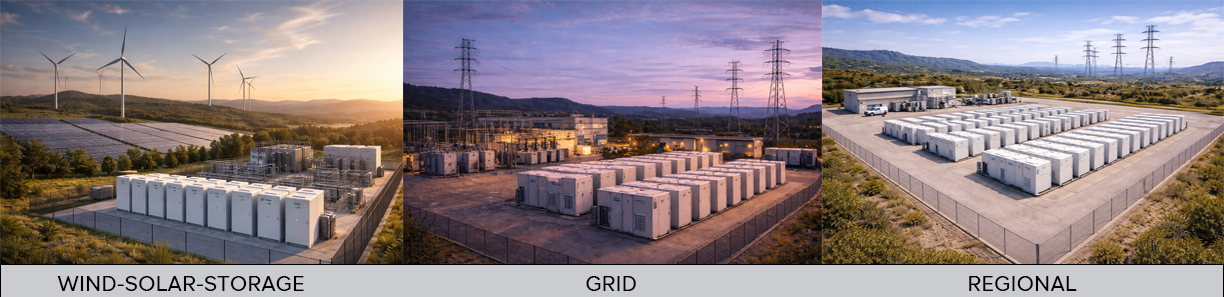
I. From Equipment to Asset
In 2026, energy investments are evaluated less on raw size and more on resilience and dependability. Centralized storage remains mainstream for large projects, but as enterprises emphasize availability, cashflow recovery, and asset liquidity, a more flexible model — distributed energy storage — is gaining momentum.
II. Centralized vs. Distributed
Centralized — still dominating capacity-oriented markets
Typically deployed in 20ft or 40ft containers with centralized PCS, unified cooling, and unified control. Best suited for large renewable bases, peak shaving, frequency regulation, and projects with ample land. Lower CAPEX and mature EPC make it predictable — but single points of failure can shut down a full site, and exit/dismantling costs are high.
Distributed — a flexible, value-oriented asset
An architectural evolution rather than "smaller-scale." Each module includes independent BMS, thermal management, fire suppression, communication, and liquid-cooling, coordinated by an upper-level EMS. Failures are confined to modules, modules are scalable on demand, and each module functions as a transferable energy asset for easier segmentation and redeployment.
III. Multi-Dimensional Comparison
Centralized fits projects with low land cost, ample timeline, and CAPEX-first goals. Distributed fits projects requiring high availability, rapid deployment, and flexible scaling.
IV. Renon's Approach: MPack 261A & Smart Matrix A
- MPack 261A — IP54-rated for high-temp/high-humidity environments, independent BMS, liquid-cooled thermal + fire suppression, parallel modules with online fault isolation, ≤20 ms on/off-grid switching.
- Smart Matrix A — integrates PCS, battery system, and EMS with built-in UPS capability for centralized dispatch consistency without single points of failure.
Together they enable a three-layer architecture: node-level autonomy, station-level coordination, and system-level dispatch — the reliability of centralized systems with the flexibility of distributed ones.
V. A Capability Threshold, Not a Trend
The future is not centralized vs. distributed — it's the right balance between stability and flexibility, assets and returns. Distributed storage sets a higher bar for engineering capability, system design, and asset-level understanding, advancing storage from engineering projects to standardized, investable assets.
Original source
View on Renon Power